

As the global specialty and commercial coffee markets experience explosive growth, independent coffee shops and regional roasteries frequently scale up into industrial-scale production. Transitioning from standalone shop roasters to a fully integrated commercial coffee roasting line is the critical step to maximizing output, ensuring flavor consistency, and minimizing labor costs.
Investing in a turnkey industrial coffee roasting plant allows coffee bean brands, wholesalers, and food processing enterprises to streamline everything from green bean intake to final vacuum packaging under one seamless automated workflow.
Core Workflow of a Modern Commercial Coffee Roasting Plant
A high-performance roasting line connects individual heavy-duty machines into an synchronized ecosystem controlled by a central PLC touchscreen system:
1. Pneumatic Green Bean Conveying & Pre-Cleaning
The process begins with raw green coffee beans hoisted via a pneumatic vacuum loader or mechanical bucket elevator into storage hoppers. Before entering the drum, beans pass through a magnetic separator and vibrating screen to remove dust, stones, and foreign debris, protecting the roaster internals.
2. Heavy-Duty Industrial Coffee Roaster (30kg – 200kg+)
The heart of the line is a high-capacity industrial roaster (ranging from 30kg to 200kg per batch). Featuring precision double-walled drums, independent frequency-inverter controls for drum speed and airflow, and real-time Artisan or PLC data logging, it ensures flawless thermal profile repeatability batch after batch.
3. Rapid Destoning & Forced Cooling Systems
Immediately after dropping roasted beans, a high-torque cooling tray drops bean temperature to ambient levels in under 3 minutes. Simultaneously, an integrated pneumatic destoner pulls out any residual heavy stones or metallic impurities to guarantee food-grade safety.
4. Eco-Friendly Smoke Elimination (Afterburners & ESP)
For urban or strict environmentally regulated manufacturing sites, smoke and volatile organic compounds (VOCs) are filtered out using high-efficiency Afterburners or Electrostatic Precipitators (ESP), achieving smoke-free, zero-emission operations.
5. Finished Bean Silo Storage & Automated Packaging
Roasted beans are temporarily stored in sealed resting silos to degas before moving to automated multi-head weighing, vertical form-fill-seal (VFFS) packaging machines, or nitrogen-flushed valve-bagging lines.
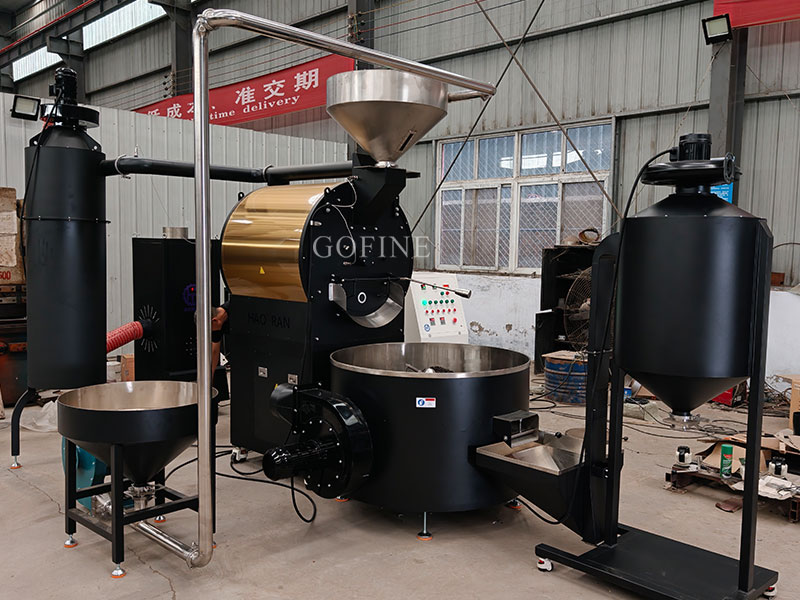
Technical Specifications & Production Line Matrix
We configure modular turnkey coffee processing lines tailored to diverse industrial output requirements:
| Line Capacity Scale | Primary Roaster Size | Hourly Output (Est.) | Recommended Support Equipment | Target Business Model |
| Medium Scale | 30 kg / batch | 90 – 120 kg/h | Destoner, Cyclone, Simple Conveyor | Regional bean wholesalers, mid-size roasteries |
| Industrial Standard | 60 kg / batch (“One-Bag”) | 180 – 240 kg/h | Destoner, Afterburner, Cooling Mixer | Commercial coffee brands, supermarket suppliers |
| Heavy Production | 120 kg / batch | 360 – 480 kg/h | Full Pneumatic Feeder, ESP, Silo Group | Large coffee manufacturing enterprises |
| Mass Processing | 200 kg+ / batch | 600 – 800+ kg/h | Fully Automated Central PLC Control Hub | Instant coffee factories, transnational brands |
Why Leading Coffee Brands Choose Our Turnkey Roasting Solutions
-
End-to-End Engineering Integration: We manage the entire project lifecycle—from factory 3D CAD layout planning, electrical schematics, and equipment manufacturing to global on-site installation.
-
Uncompromising Thermal Efficiency: Advanced burner technology and insulation reduce fuel consumption (LPG/Natural Gas) by up to 20% compared to conventional industrial roasters.
-
Smart PLC Automation: Centralized touchscreens allow operators to monitor temperatures, airflow pressure, and batch metrics with minimal manual intervention.
-
Global Safety Compliance: All equipment is built with food-grade SUS304 stainless steel and holds CE and ISO9001 certifications.
Frequently Asked Questions (FAQ)
Q: What is the typical installation and commissioning timeline for a 60kg commercial roasting line?
A: Manufacturing typically takes 40–50 days. On-site mechanical installation, pipeline alignment, gas pressure calibration, and PLC debugging generally require an additional 20–30 days depending on your factory site readiness.
Q: Can the production line handle both natural gas (NG) and liquid propane gas (LPG)?
A: Yes. Our industrial burners and micro-metering valve systems are fully customizable to match your local municipal gas supply standards and pressure requirements.
Request Your Custom 3D Plant Layout & Quotation Today!
Planning to upgrade or build a new commercial coffee roasting line? Contact our engineering specialists today to receive a customized plant workflow layout, capacity analysis, and direct factory pricing.
Online message